
The difference between a "tick-box" certificate and the ability to save a life often comes down to who is standing at the front of the classroom. If you're still feeling unsure about the transition from Occupational First Aid to the current PHECC standards, you aren't alone. Many employers and staff members feel a sense of anxiety regarding the practical assessments or worry that the training won't translate to a real-world crisis. It’s vital to feel like a "safe pair of hands" when it matters most, rather than just holding a piece of paper for the sake of a compliance folder.
This ultimate guide to the First Aid Response course Ireland provides everything you need to master the curriculum and meet HSA workplace regulations. You’ll learn how to navigate the certification process with ease and discover why paramedic-led training is the gold standard for building genuine readiness. We will walk through the legal requirements, the specific differences between initial and refresher programmes; and the practical steps to ensure you walk away with both a PHECC certificate and the confidence to act when every second counts.
Key Takeaways
- Understand why the PHECC-accredited FAR certificate is now the only recognised standard for workplace first aid in Ireland, replacing the old Occupational First Aid model.
- Learn how to navigate HSA compliance by matching your staff training levels to the specific health and safety risks within your organisation.
- Master the essential life-saving skills found in the comprehensive syllabus, from primary patient assessments to advanced Cardiac First Response techniques.
- Determine if you need to book the full three-day First Aid Response course Ireland or the shorter two-day recertification programme to keep your credentials current.
- Gain confidence by training with active paramedics who provide the street-level insights needed to handle real-world emergencies with composure and skill.
What is the First Aid Response (FAR) Course in Ireland?
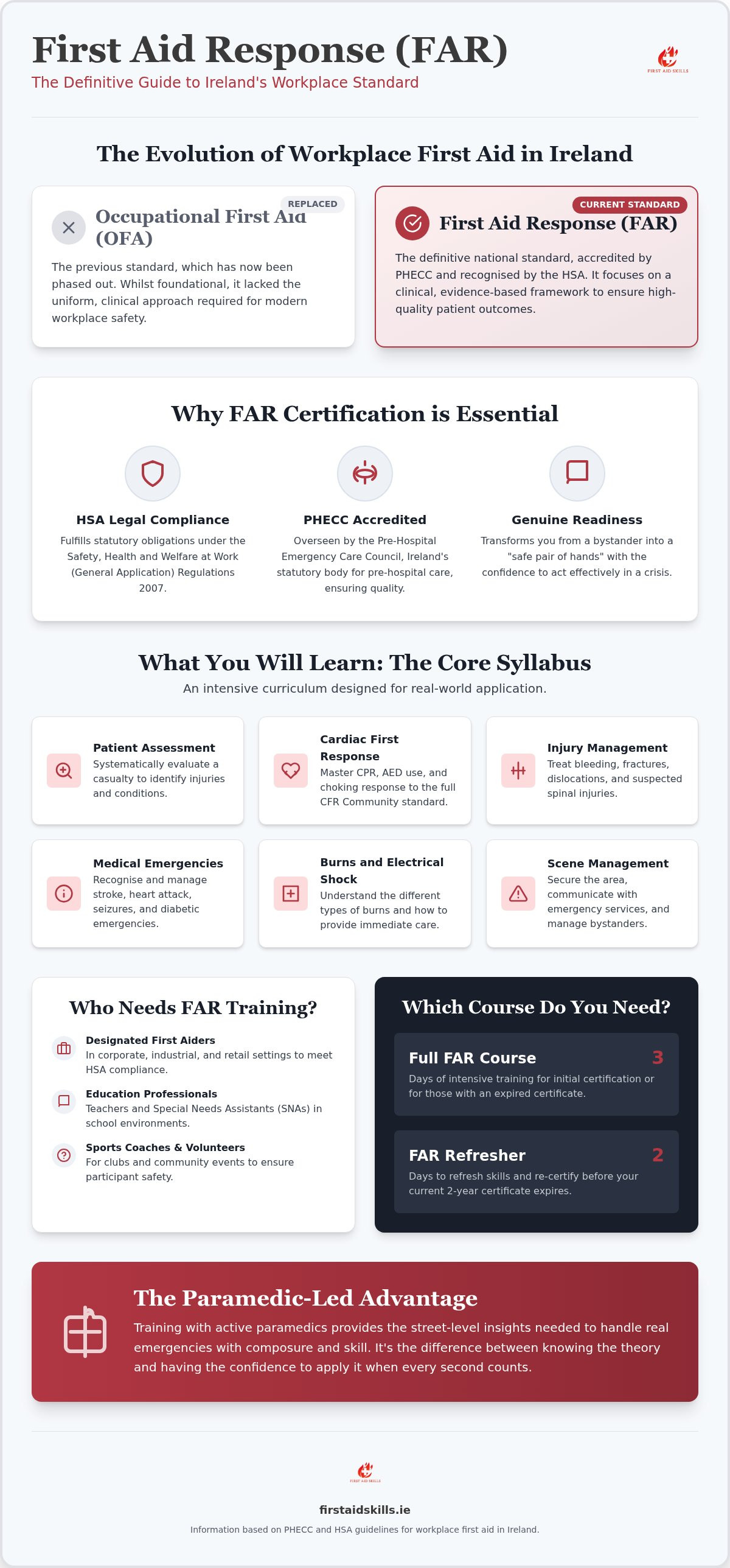
The First Aid Response (FAR) framework is the definitive national standard for clinical first aid in Irish workplaces. It represents a significant evolution from the older Occupational First Aid (OFA) model, which was phased out to create a more clinical and uniform approach to emergency care. This shift ensures that every responder follows the same evidence-based protocols, regardless of where they received their training. By moving towards a more robust framework, the training focuses on high-quality patient outcomes rather than just basic injury management.
All training and certification for the First Aid Response course Ireland is overseen by the Pre-Hospital Emergency Care Council (PHECC). As Ireland's statutory body for pre-hospital care, PHECC sets the curriculum and monitors the quality of instruction across the country. Because of this high level of medical governance, the Health and Safety Authority (HSA) recognises FAR as the gold standard for workplace first aid. It provides a "safe pair of hands" for businesses, ensuring that responders are capable of managing everything from minor injuries to life-threatening cardiac events with disciplined composure.
The Core Purpose of FAR Certification
The primary objective of FAR training is to empower you with the skills to preserve life, prevent conditions from worsening, and promote recovery. It focuses heavily on patient assessment, which is the foundation of all effective emergency care. By learning a systematic approach, you gain the confidence to take control of an emergency scene whilst waiting for professional medical services. This proactive mindset is essential for meeting statutory health and safety obligations under Irish law, specifically the Safety, Health and Welfare at Work (General Application) Regulations 2007. It's about being ready to act when it matters most.
Who Should Undertake First Aid Response Training?
While many people attend the First Aid Response course Ireland to fulfil a workplace requirement, the skills are relevant to anyone in a position of responsibility. This includes designated first aiders in corporate or industrial settings who must maintain compliance with HSA regulations. Education professionals, particularly teachers and Special Needs Assistants (SNAs), find this level of training vital for managing the unique risks found in school environments. Additionally, sports coaches and community volunteers often seek this accredited certification to ensure they can provide a high standard of care during matches or public events. It's a universal asset for anyone dedicated to the safety of their community.
The PHECC First Aid Response Syllabus: What You Will Learn
The curriculum for a First Aid Response course Ireland is intensive because it prepares you for the unpredictable nature of real-world emergencies. It moves beyond basic theory to ensure you can execute a systematic patient assessment under pressure. You will learn how to secure a scene, identify potential hazards, and communicate effectively with emergency services. This structured approach is what transforms a person from a bystander into a capable responder who can act as a "safe pair of hands" until a paramedic team arrives.
You will also gain the skills to recognise and treat life-threatening conditions that are common in both workplace and community settings. This includes identifying the early warning signs of a stroke or a heart attack. The training provides clear protocols for managing trauma, such as fractures, suspected spinal injuries, and severe bleeding. By understanding the physiological impact of these injuries, you can provide the precise care needed to prevent further harm. If you are looking to build these practical skills, choosing a First Aid Response (FAR) programme led by experienced professionals ensures you get the most out of every lesson.
Mastering Cardiac First Response (CFR)
A cornerstone of the syllabus is the integration of the full CFR Community standard. You won't just learn about CPR; you will practice it until the rhythm becomes second nature. Hands-on training with Automated External Defibrillators (AEDs) is a mandatory requirement, as these devices are critical in the "Chain of Survival." According to the Official PHECC FAR Standard, responders must be proficient in using an AED safely and effectively. Your role in this chain is often the most vital, as early intervention significantly increases the chances of a positive outcome during a cardiac arrest.
Trauma and Medical Emergency Management
Trauma management involves more than just applying a plaster. You will master practical bandaging and wound care techniques designed for significant workplace injuries. The course also covers how to recognise the signs of concussion and internal injuries, which are often invisible but highly dangerous. You will learn the correct procedures for managing burns, accidental poisoning, and environmental emergencies like hypothermia. Additionally, the syllabus prepares you for common medical crises, including asthma attacks, diabetic emergencies, and epileptic seizures, ensuring you can support colleagues or students with chronic health conditions during an acute episode.
Legal Compliance: Why FAR is Essential for Irish Workplaces
Compliance with health and safety law isn't just about avoiding penalties; it's about establishing a robust framework that protects your most valuable asset, your people. Under the Safety, Health and Welfare at Work (General Application) Regulations 2007, every employer in Ireland has a statutory duty to provide "adequate and appropriate" first aid equipment and trained personnel. While the term "adequate" can feel subjective, the Health and Safety Authority (HSA) provides clear guidance by recognising the First Aid Response course Ireland as the definitive standard for workplace compliance. Holding a valid PHECC certificate serves as a critical component of your legal defence during a health and safety audit. If an incident occurs and your designated responder lacks current, accredited training, the organisation faces significant liability.
Maintaining a valid certificate ensures your business remains compliant with evolving clinical standards. Because the FAR framework is overseen by a statutory body, it provides a much higher level of assurance than previous models. Employers must ensure that their first aiders complete a recertification programme every two years to keep their skills sharp and their legal status active. It’s a proactive step that moves your business beyond a "tick-box" exercise and into a state of genuine readiness.
PHECC vs Occupational First Aid: The Transition
The HSA phased out the old Occupational First Aid (OFA) system to align workplace response with the medical standards set by PHECC. This transition was driven by a need for a standardised national registry and more rigorous clinical oversight. Unlike the old system, the First Aid Response course Ireland ensures that responders are trained in advanced Cardiac First Response (CFR) as part of their core certification. If your staff still hold old OFA certificates, they're no longer recognised for workplace compliance once they expire. You must transition them to the FAR standard to maintain your legal standing and ensure your team has the most current life-saving knowledge.
Determining How Many First Aiders Your Organisation Needs
Deciding on the number of trained responders isn't a one-size-fits-all calculation. It requires a thorough assessment of your specific workplace hazards, staff numbers, and physical layout. For example, a high-risk manufacturing plant with 50 employees requires a different response capacity than a low-risk office environment of the same size. You should also consider shift patterns and the distance to the nearest hospital. To help you calculate the exact requirements for your site, you can consult our detailed guide on how many first aiders your workplace needs. This structured approach ensures you aren't just meeting the minimum requirements but are acting as a "safe pair of hands" for your entire team.
Preparing for Success: FAR Assessment and Certification
Approaching an assessment can often cause a sense of anxiety, especially when the skills being tested are life-saving. However, the First Aid Response course Ireland is designed to build your competence progressively, ensuring you feel like a "safe pair of hands" by the time you reach the final evaluation. The programme structure depends on your current status. If you are new to the framework, you'll complete a three-day initial course covering at least 18 hours of instruction. If you are refreshing your skills, you'll attend a condensed two-day recertification course. Both pathways culminate in a formal assessment that validates your ability to act decisively in a crisis.
The certification process involves two distinct components: a practical skills demonstration and a Multiple Choice Question (MCQ) exam. The MCQ is not designed to trip you up with medical jargon; rather, it ensures you understand the core protocols and legal responsibilities discussed throughout the sessions. You must demonstrate a clear grasp of the theory before your PHECC certificate is issued. If you are ready to take the next step in your professional development, you can book your First Aid Response assessment with our paramedic-led team to ensure you receive the highest standard of preparation.
The Practical Assessment Process
During the practical assessment, you'll demonstrate your proficiency in high-stakes skills under the calm supervision of your instructor. This includes performing high-quality CPR and the correct application of an Automated External Defibrillator (AED). You will also be asked to show competence in patient assessment and placing a casualty into the recovery position. Instructors provide continuous feedback to ensure student confidence before the final check. This hands-on approach ensures that the techniques become second nature, allowing you to focus on the patient rather than the process during a real emergency.
Maintaining Your Certification: Recertification Rules
A PHECC FAR certificate remains valid for exactly two years from the date of issue. To maintain your status as a recognised responder, you must complete a recertification course before your current certificate expires. There is no "grace period" under the PHECC standard; if your certificate lapses, you may be required to sit the full three-day course again to regain your credentials. Staying proactive with your training schedule is the best way to ensure continuous workplace compliance. You can use our FAR Recertification: Staying Compliant checklist to track your expiry dates and plan your refresher training well in advance.
The Paramedic-Led Advantage: Why Who Teaches You Matters
When you enrol in a First Aid Response course Ireland, you aren't just looking for a certificate; you're looking for the ability to act when things go wrong. There's a fundamental difference between an instructor who has studied a manual and one who has spent years on the frontline in an ambulance. Paramedics bring a level of clinical authority that textbooks simply cannot replicate. They understand the nuances of a crisis, from the sensory details of a scene to the subtle changes in a patient’s condition during shock. This lived experience creates a "safe pair of hands" environment where you can move past the theory and into the reality of life-saving.
One of the greatest benefits of paramedic-led training is the ability to answer complex "what if" questions. In a real-world emergency, situations are rarely as tidy as they appear in a training video. A paramedic instructor can provide context-rich answers based on thousands of hours in the field. Whether you're worried about managing a casualty in a cramped office space or dealing with a distressed bystander, they have been there. This expertise allows them to use "street-level" scenarios that prepare you for the chaos of a real incident, not just the controlled environment of a classroom.
Bringing the Emergency Room to the Classroom
Training with a professional who handles trauma daily helps you manage the psychological weight of being a first responder. We use real-life case studies to illustrate why rapid response is the deciding factor between a positive outcome and a tragedy. By understanding the adrenaline and anxiety that naturally occur during an emergency, you can learn techniques to maintain your composure. This focus on the mental aspect of the response leads to much better skill retention. When you've heard how a professional manages a high-pressure moment, those lessons stay with you far longer than a bulleted list on a slide.
Flexible Training Delivered Nationally
Every organisation has different risks. A primary school has different first aid needs than a construction site or a sports club. Our approach focuses on delivering on-site training that is specifically tailored to your industry's unique hazards. We provide national on-site delivery, organising group sessions that fit seamlessly into your organisation’s schedule to minimise disruption. If you want your team to be trained by those who do the job for real, book your paramedic-led FAR course with First Aid Skills today and ensure your staff are ready for anything.
Take Control of Your Workplace Safety Standards
Choosing the right First Aid Response course Ireland is about more than just meeting a legal mandate; it's about investing in the safety and well-being of your colleagues or students. You now understand that a valid PHECC certificate is the only standard recognised by the HSA for Irish workplaces. By prioritising training led by active paramedics, you ensure that your team gains the practical confidence to manage real-world emergencies with discipline and care. Whether you are looking for an initial three-day programme or a two-day recertification, the focus remains on high-quality patient outcomes and clinical excellence.
Our team of PHECC-registered instructors provides national on-site training tailored to your specific environment. This ensures your responders are truly ready when it matters most. Don't leave your compliance to chance. It's time to build a team that can act with certainty. Secure your place on a Paramedic-led First Aid Response course today and gain the expertise that only frontline experience can deliver. We are here to support you in becoming a proactive, prepared, and capable responder for your community.
Frequently Asked Questions
How long does a First Aid Response (FAR) certificate last in Ireland?
A First Aid Response (FAR) certificate is valid for exactly two years from the date of issue. To remain compliant with workplace regulations, you must complete a recertification course before this expiry date. There is no grace period permitted under the PHECC standard. If you let your certification lapse, you'll likely need to attend the full three-day programme again to regain your status as a recognised responder.
Is the FAR course the same as Occupational First Aid?
No, the First Aid Response framework replaced the old Occupational First Aid (OFA) system as the national standard for workplace first aid. While they share some similarities, FAR is a more comprehensive clinical standard overseen by PHECC. It includes advanced Cardiac First Response modules that weren't as robust in the old OFA syllabus. The HSA now only recognises the FAR standard for new workplace first aid certifications.
Can I do the First Aid Response course online?
You cannot complete a First Aid Response course Ireland entirely online because the practical skills assessment requires in-person supervision. Some providers offer blended learning where the theoretical components are studied virtually; however, you must attend a training centre for the hands-on demonstrations. This ensures you can correctly perform CPR, use an AED, and manage trauma scenes under the watchful eye of a qualified instructor.
How many days does the First Aid Response course take?
An initial First Aid Response course takes three days to complete, involving a minimum of 18 hours of instruction. If you are already certified and need to refresh your skills, the recertification programme is condensed into two days. Both versions of the course include the mandatory practical assessments and the Multiple Choice Question exam required to secure your PHECC certification and maintain workplace compliance.
What is the difference between FAR and CFR training?
Cardiac First Response (CFR) is a specialised module focused on CPR and AED usage, whereas FAR is a comprehensive first aid qualification. Every FAR course includes the full CFR Community standard as part of its syllabus. While you can take CFR as a standalone half-day course, it doesn't meet the full HSA requirements for a designated workplace first aider, which requires the broader FAR certification.
What happens if my FAR certificate has already expired?
If your certificate has already expired, you are no longer considered a valid first aider and must attend the full three-day First Aid Response course Ireland again. PHECC regulations are strict regarding expiry dates to ensure that life-saving skills remain sharp. You cannot attend the two-day refresher course if your previous certificate is out of date, so it's vital to track your expiry window carefully.
Is the FAR course recognised by the Health and Safety Authority (HSA)?
Yes, the FAR course is the only first aid standard currently recognised by the Health and Safety Authority for the Irish workplace. The HSA transitioned to this model to ensure a high, uniform standard of pre-hospital care across all industries. By holding this certification, employers can demonstrate that they have met their statutory obligations under the Safety, Health and Welfare at Work Regulations.
Do I need any prior experience to take a First Aid Response course?
You do not need any prior medical or first aid experience to enrol in a First Aid Response course. The programme is designed to take you from a complete beginner to a confident responder over the course of three days. Instructors use a methodical approach to build your skills step-by-step, ensuring you feel comfortable managing an emergency scene and providing patient care regardless of your professional background.